
One of our clients is documenting the process of transforming their bungalow with passive solar addition  (Design brief here) with a image laden blog. Check it out!
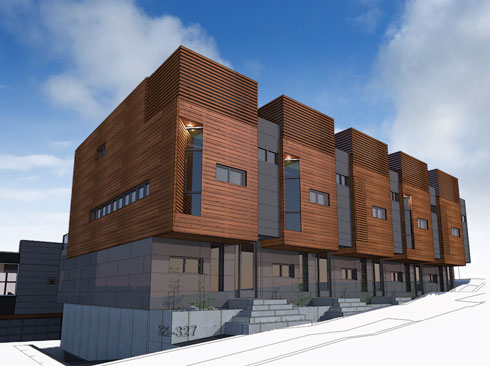 Urban Olympic is a community of 9 townhouses, and will  mark a couple of firsts for us:  our first Passive House project and also our first project under the new Seattle multifamily code.
Passive House is a rigorous green building standard focused on exclusively on energy consumption, energy efficiency and air quality. They are super insulated, almost airtight, and therefore need very little energy input to heat (up to a 90% reduction of the energy used by a typical code compliant house).  The heat from equipment, people and lighting retained within the insulated building envelope essentially replaces the furnace/boiler as the primary heat source. Fresh air is conditioned through a Heat Recovery Ventilator (HRV) with the exhausted air. Although solar gain does factor into the equation, Passive Houses are not passive solar houses.
Urban Olympic, to my knowledge, will be the first multifamily Passive House in the United States.
Thank you to all our friends and colleagues that came out last night to help us celebrate our new office space! Â Standing room only! Â Now if only one of us had thought to snap a picture when the crowd was actually there....
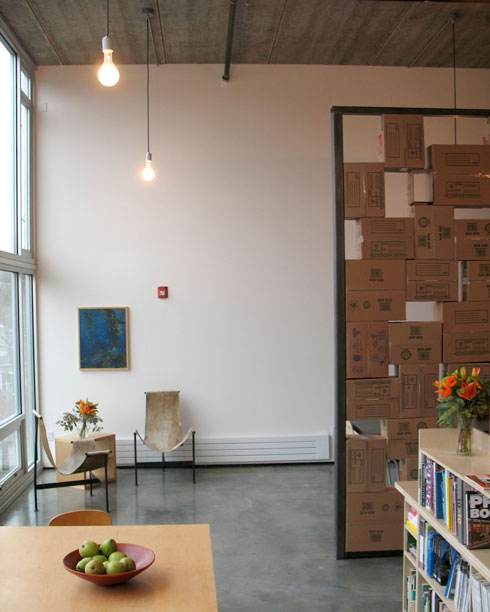
Since we haven't decided what to do with the big wall that separates the desks from the conference/copy space, we took all the recycled moving boxes, cut them down on the table saw, then glued them up, thus recycling them again. Â Perfect for the party!
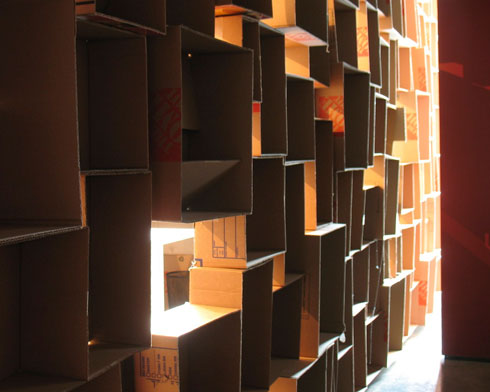
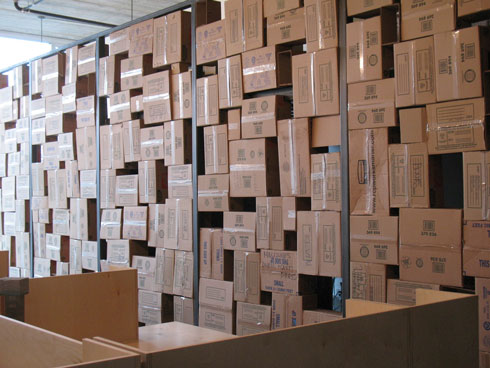
 Our new office at 115 North 36th Street is fully operational. Â Now back to work....
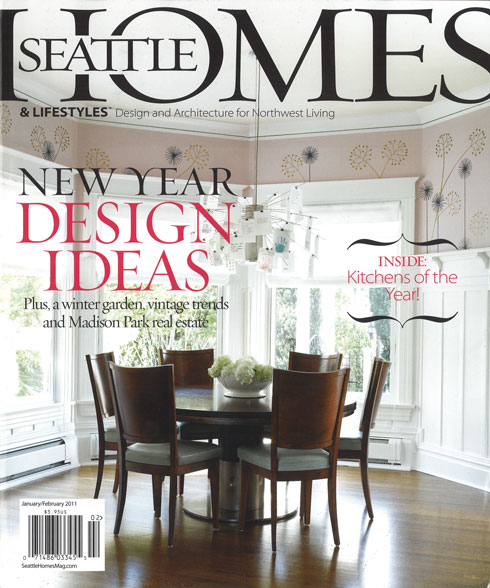 Congratulations to Randy and Sage! Their renovation is featured in Seattle Homes and Lifestyles, and even made the cover! Â Here is a link to the article:
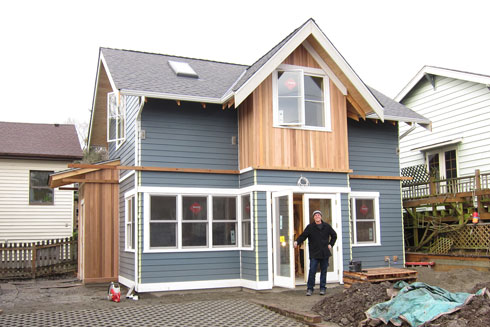 The cottage in Phinney Ridge is taking shape--it is all dried in and the drywall is up. Â One of the owners is pictured above savoring being on the cutting edge of increased density in Seattle's single family zoning!
 The new space is coming along: walls are up and the electricians are there now. The storage loft to the right over the copy room is decked.

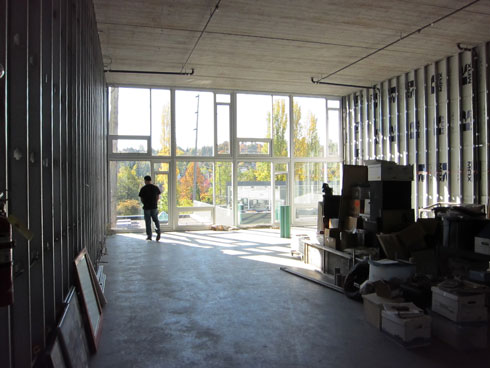 After ten (ten!) years in our current location we are moving to a new space in Fremont into Dave Boone's great building @Â 115c N.36th overlooking the Ship Canal.
As you can see, it is perfectly raw and we'll be burning the midnight oil to get it into shape for the new year.
After the holidays, we'll be having a building wide celebration in concert with D.Boone Construction, and Cascade Bicycles.
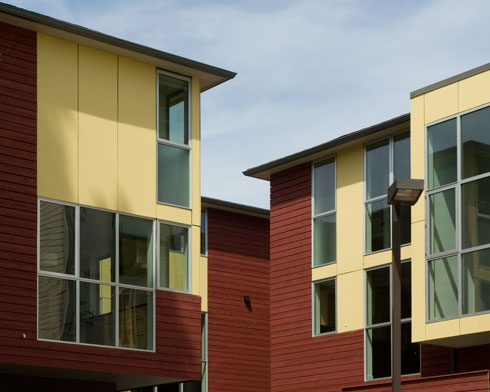 The Fremont Town Homes completed last year are going to be on a green design tour hosted by Mark Mays of ecohome seattle. This is a great opportunity to get inside and kick the tires of some really interesting sustainably minded projects.
For more information see Mark's annoucnment below or contact him directly at Mark Mays 425.280.4223. Follow this link for a list of all the addresses and an option to view them on a map, or cick through to view the invite in its entirety.
Greetings Green Home Tourists!
Here are the final four selections for the Green Home Tour this Sunday starting at 1pm at Martha Rose’ Fish Singer Place development in Shoreline. The address is 433 Fish Singer Place with access from Dayton Ave N., just a couple houses south of N. 160th just up the hill from Sears and Central Market on Hwy 99. We will spend 45-60 minutes at Fish Singer as there is so much to see and Martha will be there to help explain the green features and systems. The site development is amazing with many eco-friendly functions along with the great aesthetics.
We can carpool or caravan to the next homes on the tour. For those that asked, there is no charge for the tour. We are fairly passionate about green homes and are happy to share the passion with others. Of course we are happy to provide real estate services for those that would like us to provide them, but this is all about seeing, learning and appreciating the fantastic work these architects and builders have done in their green home implementations without a bunch of sales hype.
The second home is a green remodel just a few blocks from the Phinney Center. This is one of the best Built Green remodels I’ve seen in terms of staying within the character of the original design as well as the neighborhood, and the quality of craftsmanship, materials and green systems is fairly rare compared to many of the green remodels I’ve seen.The architect was Amy Williams with Blue Canyon Construction as the contractor. I’m supposed to be getting a copy of the checklist so we can know more about what is behind the walls and under the floors that would demonstrate a good green home design.
Home #2 on the map is a Four Star Built Green home that has many green features and systems which you will already have seen at Fish Singer, but this is definitely one of the better infill townhomes I’ve seen with tight energy envelope, plumbed for solar hot water, great daylighting, nice choice of materials and great feng shui. This home was designed by Stefan Hampden at Cast Architecture and was presented at last year’s NW EcoBuilders Guild 10x10x10 event.
The last home on the tour is in a high density luxury home development, but really it is not so ostentatious like the Street of Dreams green homes with massive square footage. I’m sure the pricing has more to do with the location and views, but the unique geothermal system along with the overall energy efficiency design, choice of green materials,and high quality craftsmanship definitely makes this home worth seeing. The listing broker will be available to answer detailed questions about the home.
Here is the NWMLS link if you’d like to get more details about the homes and preview some pictures.
Click the following URL to see the Listings: http://www.matrix.nwmls.com/DE.asp?ID=1059716656
<<...>> Look forward to seeing everyone Sunday and feel free to pass this email on to anyone else you think might be interested.
Mark Mays Real Estate Broker LEED Green Associate CHAMPIONS REAL ESTATE SERVICES 525 5th Ave S. Suite 100 Edmonds, WA 98020 Cell: 425-280-4223 Fax: 206-905-0810 mark@mays108.org www.ecohomeseattle.com
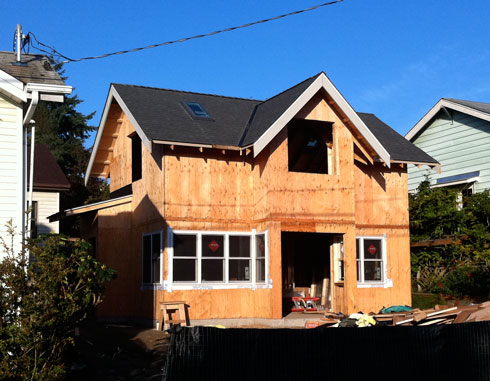 The Widner's cottage is starting to take shape!
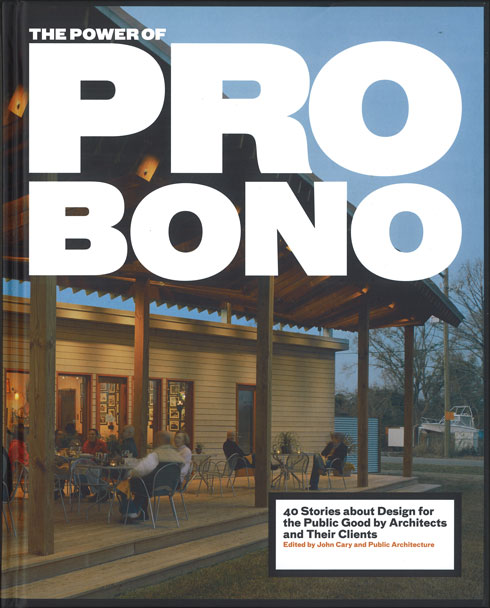 John Peterson, of Public Architecture, is coming to town on October 20th to give a talk on how pro bono design is making a difference. Â His firm has been behind a national effort, call the One Percent, to mobilize architects to donate 1% of their time per year toward pro bono causes.
Recently they've published a book called the Power of Pro Bono detailing 40 project nation wide where architects have donated their time toward great causes. CAST architecture's first pro bono project, the Interbay P-Patch is featured in the book.
We joined up with the One Percent several years ago after finishing the first project for the P-Patch, and have since completed several, with more on the way. I heartily recommend public service as an excellent way for architects to use their unique skill set to improve the community. Â Plus, personally, it feels great to know that you've made a difference in the lives of some of your neighbors.
Here are the details for the talk:
Wednesday, 10/20
Pan Pacific Hotel
2125 Terry Avenue, Lakefront Room
Cocktails start at 5:30, the talk starts at 6:15, with dessert and coffee afterwards.
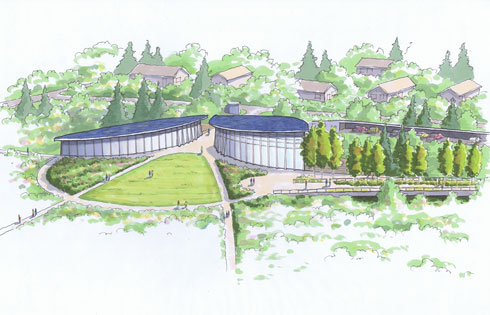 I have been collaborating with Susan Black and Associates to formulate a vision for the expansion of the Washington Park Arboretum facilities, as part of the SR 520 replacement and the demolition of the highway ramps that currently dominate the north end of the Park.
With this project, we are proposing a " new gateway structure to orient visitors, provide space for general services and curation/collection exhibits, and fulfill many of the aims of the 2001 Master Plan. As conceptualized, the development respects the history of the site and reclaims the altered landscape to natural, healthy conditions. It will provide organization, orientation, and education for visitors as a means to explore the greater Arboretum.

As a gateway, the design will put visitors in the frame of mind for the study and enjoyment of the Park. Balancing educational needs and recreation activities as functions that informally overlap and inform each other, the facility welcomes both types of visitor and enfolds them in the living greenness of the Arboretum/Lake Washington edge environment. The building concept blends with the naturalistic organization of the site with minimal visual impact and performs as a closed loop system with regard to energy and water, using only resources collected on site. The concept also enhances the connectivity to the adjacent neighborhood and trail system and welcomes pedestrian and bike traffic.
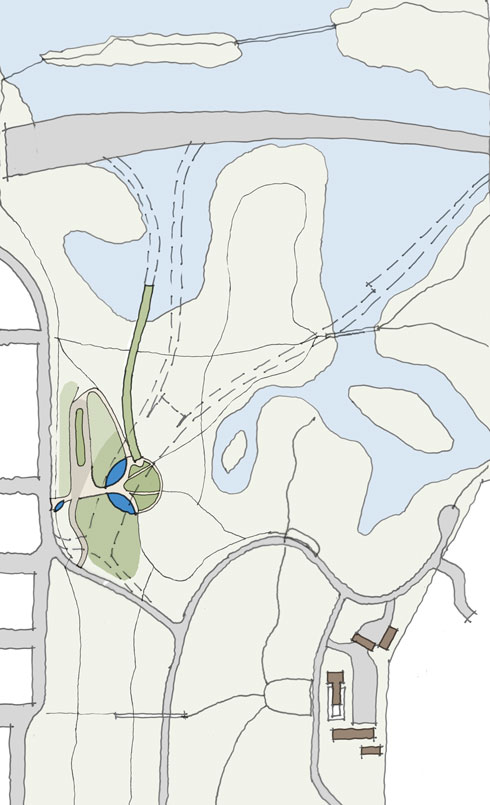
The buildings are gently folded into a rolling wetland rise like leaves blown in on the wind. The roofs are gently articulated to provide shelter and solar access. Rammed earth walls announce the gateway yet continue uninterupted through the glass to become an integral part of the ambiance of the facility. Glass walls provide an invisible barrier to the surrounding landscape during the day. In the evening, light from the buildings spills out onto grounds muted by the vegetation foliage.

Retaining a small remnant of the “flyover†bridge allows for the development of an elevated promenade for the establishment of a “pier gardenâ€. The pier would be planted in a series of linear landscapes culminating in an overlook of the southern waterway of the Mountlake Cut. The pier garden provides the visitor a new perspective of the northern limits of the Arboretum, Foster Island and the day-lighted Arboretum Creek." (from the Concept Plan)
Ideally, the building will be designed to the standards of the Living Building Challenge. Â I've anticipated about 75kW of photovoltaics on the roof, plus a ground source heat pump for building climate control, harvesting all rain water for the building's use and to irrigate the demonstration gardens.
We've only just put this out into the public sphere for comments, and I can imagine that we'll have some lively discussions about how a modern structure fits within the Olmsteadian structure of the park. Â I ultimately think that the contemporary architecture will best serve the Foundation, rather than grafting high performance energy and sustainable systems onto something that is overtly historicist. Â The Washington Park Arboretum can look both both into its own history and the future to chart a path for success in it's second century.
Renderings courtesy of Lambert Design Studio